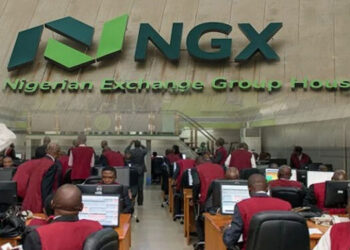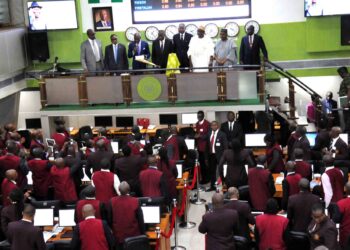





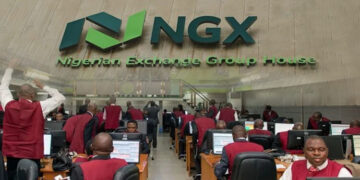
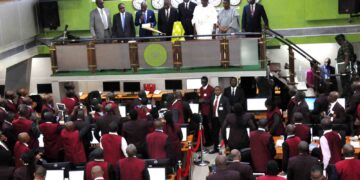

















LAGOS — The prolonged bull run on the Nigerian Exchange (NGX) hit a significant speed bump at the start of the week. According to trading data published on Tuesday, June 16, 2026, the local bourse closed deep in the red on Monday, with investors losing a staggering N945 billion in market capitalization.
The sharp downturn was primarily driven by aggressive profit-taking and structural re-pricing across major oil marketing equities and banking heavyweights, notably FBN Holdings (First HoldCo).
The All-Share Index (ASI) retraced downward from its recent highs, reflecting immediate market adjustments as institutional investors react to a fundamentally altered global energy landscape and shifting domestic liquidity positions.
The Anatomy of Monday’s Sell-Off
The nearly trillion-naira market contraction was highly concentrated in sectors that had previously led the 2026 market expansion.
- The Oil Marketing Reversal: Major downstream and upstream energy equities bore the brunt of the sell-off. Following the weekend’s historic announcement of a comprehensive peace accord between the U.S. and Iran—which crashed global crude benchmarks down to the $65–$70 range—the premium on oil stocks evaporated. Investors aggressively rotated out of energy counters, anticipating compressed nominal margins for resource exporters in the second half of the year.
- The First HoldCo Pullback: FBN Holdings (First HoldCo) acted as the primary banking sector drag on Monday. The financial heavyweight faced intense selling pressure, breaking its recent upward momentum. Analysts attribute the pull-back to portfolio rebalancing, as asset managers lock in year-to-date banking alpha ahead of anticipated changes in the central bank’s monetary policy trajectory.
- Broad Profit-Taking: The downward pressure quickly extended to highly valued consumer goods and industrial tickers, as institutional desks triggered stop-loss limits and capitalized on the phenomenal triple-digit returns generated through May.
Systemic Drivers: T+1 and the Liquidity Filter
Beyond the immediate geopolitical trigger of cheaper oil, the current market dynamic is operating under newly modernized structural rules.
The SEC’s recent transition to a T+1 settlement cycle has significantly enhanced market velocity. While this structure unlocks trapped capital faster during a rally, it also accelerates the speed of liquidations during a correction.
Institutional desks can now exit large positions and settle cash within 24 hours, magnifying intraday volatility when a market-wide “Risk-Off” sentiment takes hold.
Additionally, the drop in headline inflation to 15.93% means that while equities remain an excellent long-term hedge, the pressure to chase speculative capital gains at any valuation has cooled slightly. Investors are becoming far more discerning, prioritizing fundamental value and dividend yield safety over pure momentum.
The Outlook: A Technical Correction or a Trend Reversal?
Despite Monday’s N945 billion contraction, market analysts view the drop as a healthy and expected technical correction rather than a structural collapse.
The macro drivers for the non-oil sector remain robust; lower global oil prices will significantly reduce landing costs for imported refined products and raw manufacturing inputs, eventually expanding profit margins for listed consumer staples and manufacturing firms.
As the market absorbs the oil price shock, capital is expected to re-stratify. Companies that have insulated themselves from macroeconomic shifts—particularly those utilizing independent infrastructure and Solar-Hybrid systems to bypass traditional energy grids—will likely see renewed demand once the initial profit-taking wave subsides.
For patient capital and equity mutual funds, this correction offers an attractive entry point to accumulate quality corporate moats at a discount.