

























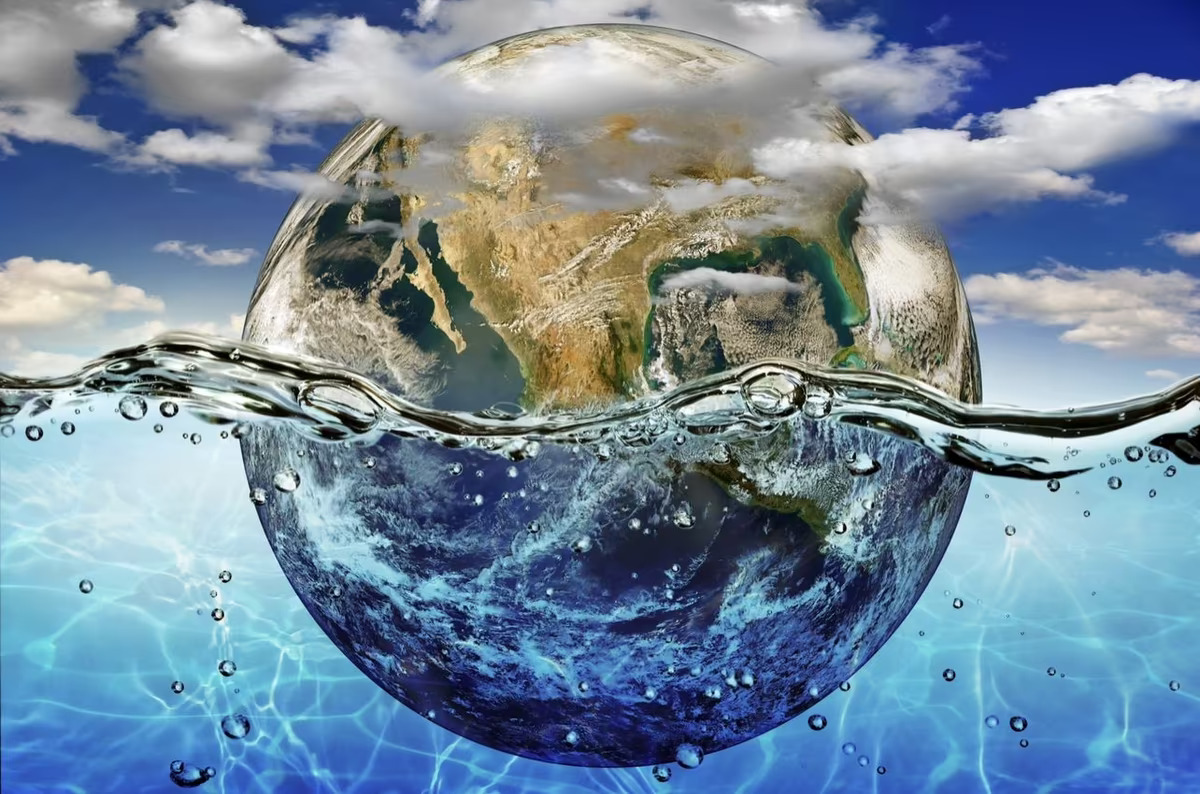
Every time you take a sip of water, you’re consuming something far more ancient than you might imagine. The water flowing through your tap, filling Earth’s oceans, and sustaining all life on our planet carries within it a remarkable secret: much of it is older than Earth itself—and even older than our Sun.
This extraordinary revelation has emerged from cutting-edge astronomical research that traces the journey of water from the cold depths of interstellar space to the glass in your hand.
The Cosmic Journey of Water
The story begins not 4.5 billion years ago when Earth formed, but even earlier, in the frigid expanses of a giant molecular cloud that would eventually give birth to our entire solar system.
These vast clouds, composed primarily of hydrogen with traces of helium, oxygen, and carbon, drift through space at temperatures barely above absolute zero. Within these cosmic nurseries, a process as elegant as it is fundamental unfolds.
As oxygen atoms encounter tiny grains of silicate and carbonaceous dust floating in the cloud, they freeze and adhere to these microscopic surfaces. The lighter hydrogen molecules, meanwhile, hop around on these frozen dust grains like cosmic dancers until they encounter their oxygen partners.
When they finally meet, they react to form water ice—not just the regular H2O we know, but also heavy water containing deuterium (HDO), an isotope of hydrogen that carries an extra neutron in its nucleus.
This deuterium is particularly special. Created only in the seconds immediately following the Big Bang, deuterium exists in the universe at a ratio of just one atom for every 100,000 regular hydrogen atoms.
Yet in the extreme cold of these molecular clouds, something remarkable happens: a phenomenon called super-deuteration dramatically increases the concentration of deuterium in the forming water ice, creating a cosmic fingerprint that scientists can detect billions of years later.
The Four-Step Cosmic Recipe
Researchers Cecilia Ceccarelli from the Institute for Planetary Sciences and Astrophysics in Grenoble, France, and Fujun Du from the Purple Mountain Observatory in Nanjing, China, have mapped out a four-step process that explains how this ancient water made its way to Earth.
Step One: The Cold Phase In the initial stage, water ice forms mantles around dust grains in the molecular cloud at temperatures of only a few degrees above absolute zero. This extreme cold triggers super-deuteration, creating water with unusually high concentrations of heavy hydrogen. These ice-covered dust grains become the guardians of water’s cosmic heritage.
Step Two: The Protostar Phase As gravity begins to pull matter toward the center of the molecular cloud, a protostar starts to form. The gravitational energy converts to heat, warming the surrounding material to about 100 Kelvin (still a bitter -173 degrees Celsius).
This warmth causes the ice on the dust grains to sublimate into water vapor, creating what astronomers call a “hot corino”—a warm envelope surrounding the forming star. These hot corinos contain extraordinary amounts of water vapor—typically about 10,000 times more water than exists in all of Earth’s oceans.
Step Three: The Protoplanetary Disk The forming star begins to rotate, and the surrounding gas and dust flatten into a spinning disk. In the coldest regions of this protoplanetary disk, the water vapor from step two condenses back into ice, once again coating the same population of dust grains. Crucially, these water molecules now carry the isotopic signature of their entire cosmic journey.
Step Four: Planetary Formation Finally, planets, asteroids, and comets begin to coalesce from these ice-covered dust grains and the larger bodies they form. The water that eventually reaches Earth through this process carries with it the chemical memory of its 4.5-billion-year journey through space.
The Deuterium Detective Story
The key to unraveling this cosmic mystery lies in deuterium ratios—the proportion of heavy water to regular water. If Earth’s water had formed locally during the planet’s creation, it would have a deuterium ratio matching that of the early solar nebula.
Instead, Earth’s water shows deuterium concentrations about ten times higher than would be expected from local formation alone.
This elevated deuterium signature can only be explained by the super-deuteration process that occurred in the original molecular cloud. The extreme cold of interstellar space created conditions where deuterium became preferentially incorporated into water molecules at rates impossible to achieve under any other known circumstances.
When scientists built computer models to test whether the young Sun alone could have produced today’s deuterium levels in our solar system’s water, the models fell far short. The only way to account for the observed ratios is to acknowledge that 30 to 50 percent of our solar system’s water—including much of Earth’s supply—predates the Sun itself.
Evidence from Earth’s Ancient Past
The story becomes even more compelling when we examine Earth’s earliest geological record. Recent research published in Nature Geoscience by Hugo Olierook and Hamed Gamaleldien from Curtin University provides evidence that fresh water and dry land existed on Earth by 4 billion years ago—much earlier than previously thought.
Their study focused on ancient zircon crystals from the Jack Hills in Western Australia, some of the oldest mineral grains on Earth. These crystals, remarkably resistant to weathering and alteration, serve as time capsules preserving chemical signatures from Earth’s earliest history.
By analyzing the oxygen isotope ratios in these ancient crystals, the researchers found evidence of fresh water interacting with rocks over 4 billion years ago.
This discovery is significant because fresh water and emerged land go hand in hand—you cannot have fresh water without substantial dry land to separate it from the salty oceans. The presence of both conditions so early in Earth’s history suggests that the stage was set for life much sooner than previously imagined.
Implications for Life in the Universe
The realization that water is a cosmic inheritance rather than a local solar system product has profound implications for astrobiology and our search for life beyond Earth.
If the formation of our solar system was typical rather than exceptional, then the findings suggest that interstellar ices are abundantly available for all developing planetary systems throughout the galaxy.
Since all life as we know it depends on water, this cosmic abundance dramatically improves the odds that other planetary systems possess the fundamental ingredient necessary to support life.
Rather than being a rare accident of local conditions, water appears to be a standard feature of planetary formation—a cosmic birthright that accompanies the creation of solar systems throughout the universe.

The Planetesimal Delivery System
While the cosmic origin of much of Earth’s water is now established, questions remain about exactly how this ancient water reached our planet.
The research suggests that planetesimals—the building blocks that eventually formed planets—were the primary delivery mechanism rather than the dramatic bombardment of comets from the outer solar system that some scientists had proposed.
This conclusion comes from comparing the deuterium ratios in Earth’s water with those found in comets and meteorites. While comets often show deuterium concentrations too high to account for Earth’s water composition, the ratios in certain types of meteorites align much better with terrestrial values.
This suggests that Earth accumulated its water supply gradually during the planet-building process rather than receiving it later through comet impacts.
Ancient Waters and Modern Life
The implications of this research extend far beyond academic curiosity. Every molecule of water that flows through rivers, fills clouds, nourishes plants, and sustains human life carries within it the memory of processes that occurred before our planet even existed.
We are quite literally drinking from a cosmic well that has been flowing for longer than the Sun has been shining.
This ancient heritage connects us directly to the broader universe in ways that were unimaginable just decades ago. The water in your body has traveled through interstellar space, witnessed the birth of stars, and participated in the fundamental chemical processes that made life possible.
It serves as a physical link between Earth’s biosphere and the cosmic processes that govern the formation of planetary systems throughout the galaxy.
As our understanding of water’s cosmic origins deepens, new questions emerge. Researchers are working to refine estimates of exactly what fraction of Earth’s water predates the solar system.
They’re also investigating how this ancient water interacted with other important chemicals during Earth’s formation, including carbon and the molecular building blocks of life.
Advanced telescopes are now allowing astronomers to observe water in forming planetary systems around other stars, providing direct evidence of the same processes that delivered water to Earth billions of years ago.
These observations confirm that water formation and delivery appear to be standard features of planetary system development rather than rare exceptions.
Conclusion
The discovery that Earth’s water is older than our planet and Sun represents one of the most remarkable revelations in modern astronomy. It transforms our understanding of Earth’s place in the cosmic story, revealing that our planet inherited its most precious resource from processes that began long before the solar system itself took shape.
This cosmic perspective on water’s origins offers both humility and hope: humility in recognizing that Earth’s habitability depends on cosmic processes far greater than our planet alone, and hope in understanding that the ingredients for life appear to be widespread throughout the universe.
Every glass of water we drink connects us to this grand cosmic narrative, reminding us that we are not separate from the universe but intimately connected to its deepest processes.
As we continue to explore the cosmos and search for life beyond Earth, we carry with us the knowledge that water—the universal solvent and the foundation of life as we know it—is not a rare accident but a cosmic birthright, flowing through the universe since before our Sun began to shine.