
























From nursery school to the Nigerian Bar, Oluwabusayo Ifonlaja has never finished second. His secret? A relentless pursuit of perfection.
“What a surreal feeling!” he exclaims, still processing the magnitude of his achievement. And surreal it is—because in a country where academic excellence is fiercely contested, Ifonlaja has done something that borders on the impossible: he’s never lost.
Not once.
From nursery to primary school, from secondary to university, and now at the Nigerian Law School—Nigeria’s most prestigious legal institution—Ifonlaja has claimed the top spot every single time.
It’s a streak so consistent it seems almost fictional, yet here sits the soft-spoken achiever, armed with a perfect 5.0 CGPA and enough awards to fill a small museum.
The Making of a Legend
“I’ve always come out of every institution not only as one of the top performers but the very top performer,” Ifonlaja reflects. “Indeed, I am blessed.”
But blessing, as any serious student knows, is just the beginning. What sets Ifonlaja apart isn’t divine favor—it’s an almost obsessive dedication to preparation that would make Silicon Valley entrepreneurs look lazy.
“Proper Preparation Prevents Poor Performance,” he states matter-of-factly. “There is just no magic formula.” Oh, but there is, and it’s far more demanding than most people are willing to accept.
His routine at law school was monastic in its simplicity: “Class, reading, and sleep. Due to the overwhelming demands of law school, it was pretty much it.” Beyond religious obligations, everything else was sacrificed at the altar of academic perfection.
The man operated on a schedule so regimented that those close to him knew exactly where he’d be at any given time. His days began before dawn, armed with a systematic approach that treated each lecture like a military operation.
He’d study before class to contribute meaningfully to discussions, then study after class to cement the knowledge. When others were socializing, he was highlighting authorities in his notes.
When others were sleeping, he was staying up all night during court externship, battling malaria while maintaining his impossible standards.
The Pressure Cooker
“Every hour at the Nigerian Law School was challenging for me,” Ifonlaja admits. The academic pressure was crushing enough, but financial and emotional challenges added layers of complexity that would have broken lesser minds.
There were moments of doubt—of course there were. During his final year at university, he submitted entries for numerous essay competitions and won… nothing.
Not a single victory. “Naturally, I was disheartened,” he recalls. But rather than accept defeat, he diagnosed the problem with surgical precision: “I wasn’t winning simply because I wasn’t just good enough at the time.”
The response was vintage Ifonlaja: he didn’t lower his standards; he elevated his skills. He studied winning entries, learned from those who had succeeded before him, and transformed failure into a learning laboratory. The result? Four national essay competition victories in a single year.
“Failure is only a precedent to success; it is not the final destination,” he declares, quoting Thomas Edison with the authority of someone who’s lived the principle.
The 18-Award Sweep
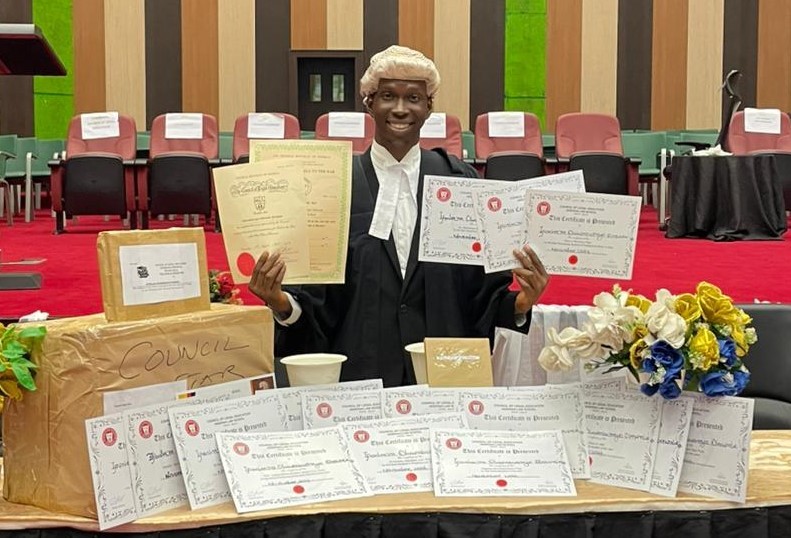
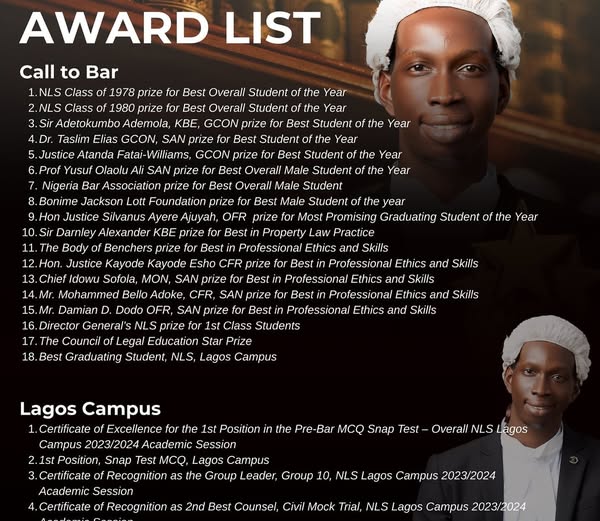
The numbers from his law school graduation are staggering. Eighteen national awards, including prizes from the most prestigious names in Nigerian legal education: the NLS Class of 1978 and 1980, Sir Adetokumbo Ademola, Dr. Taslim Elias, and the Body of Benchers. He didn’t just win—he monopolized excellence.
“These sum up the headlines,” he says with characteristic understatement. “However, most importantly, beyond the success of today… the journey was one woven with threads of relentless effort, each stitch a testament to the dedication we all put into this dream.”
But perhaps the most telling award was his leadership of a study group while maintaining his academic dominance.
Conventional wisdom at the Nigerian Law School holds that group leadership is academic suicide—the administrative burden supposedly makes top grades impossible. Ifonlaja proved that wisdom wrong through what he calls “proper group structure” and time management so precise it bordered on the supernatural.
The Philosophy of Perfection
“If 100 is attainable, why 99.9?” Ifonlaja asks, and the question reveals everything about his mindset. This isn’t about being good enough—it’s about being the best, period.
His approach to law school was almost militaristic in its precision. He’d enter every class with prior knowledge of the material, turning lectures into interactive discussions rather than passive absorption.
He created authority books, then evolved to highlighting directly in his notes. When one system reached its limits, he’d adapt, iterate, and improve.
The flexibility within rigidity is what separated him from mere grade-grubbers. “The ability to be flexible with routines is pertinent,” he explains. “I was able to systematically make little changes to study patterns. Some were a result of growth, and some, the need to adapt to current circumstances.”
The Vulnerability Factor
For all his achievements, Ifonlaja remains surprisingly human. He speaks candidly about moments of self-doubt, the pressure of expectations, and the challenge of maintaining impossible standards. “The act of doubting oneself is natural, but what you do after is what matters,” he reflects.
During one particularly brutal law school exam—five courses in three hours—he was devastated by his inability to complete significant portions, despite knowing the answers. It took a mentor’s phone call to restore his perspective and remind him that knowing the answers was sufficient at that stage.
These moments of vulnerability make his success more, not less, impressive. They reveal someone who’s conquered not just academic challenges but the internal demons that plague every high achiever.
The Future Beckons
Now, standing at the threshold of his legal career, Ifonlaja faces the ultimate test: translating academic excellence into professional impact.
His goals are characteristically ambitious—he wants to study at Harvard, Oxford, or Cambridge, become a professor while maintaining an active practice, and eventually rank among the world’s finest legal practitioners.
“I studied law because I wanted to be a lawyer and make an impact,” he states simply. But given his track record, betting against him seems like a losing proposition.
His particular passion lies in International Humanitarian Law—”the Law of War”—a field where his combination of intellectual rigor and moral clarity could prove transformative.
“My interactions with the International Committee of the Red Cross… further spurred my interest in the field,” he explains, adding another layer to his already impressive résumé.
The Ifonlaja Method
For students struggling with consistency, his advice is deceptively simple: “What distinguishes excellent people from average people is the level of consistency in putting in the work.” But consistency, he notes, requires discipline, and discipline requires sacrifice.
The sacrifice is real and total. Social life, hobbies, even basic comfort—all secondary to the pursuit of excellence. It’s a path that most won’t choose and fewer still can sustain. But for those willing to pay the price, Ifonlaja’s method offers a blueprint for transcending ordinary achievement.
“Before one knows it, it becomes second nature,” he promises. “Having accountability checks is also pivotal.”
What’s Next
As Oluwabusayo Ifonlaja transitions from student to practitioner, he carries with him something far more valuable than awards or accolades: proof that excellence isn’t accidental. It’s the result of systematic preparation, unwavering discipline, and the courage to maintain impossible standards when everyone else settles for good enough.
In a world increasingly comfortable with mediocrity, Ifonlaja represents something almost anachronistic: the belief that if something is worth doing, it’s worth doing perfectly. His story isn’t just about academic success—it’s about the relentless pursuit of human potential.
The sun may have set on his student days, but for this unbreakable mind, the real work is just beginning.
Oluwabusayo Ifonlaja, LL.B (First Class), BL (First Class), was called to the Nigerian Bar on July 10th, 2025, as the Best Graduating Student out of over 7,000 candidates. He currently practices law while preparing for postgraduate studies at Ivy League institutions.