





















Halima Buba, the seasoned Managing Director of SunTrust Bank, had seen plenty in her 20-year banking career—stints at Zenith, Oceanic, Ecobank, and others.
But nothing quite prepared her for what the Economic and Financial Crimes Commission was about to demand: the immediate transfer of ₦11 billion from a client’s account. No court order. No legal niceties. Just hand it over. Crazy, isn’t it?
The phone call that changed everything came on a Tuesday morning in April of 2025.
“The executives requested a valid court order to authorise the transfer, citing fiduciary responsibilities,” an insider told us. A reasonable request, you’d think. After all, banks aren’t in the business of moving billions on verbal commands, regardless of who’s asking. This we can confirm.
The EFCC, however, had other ideas. Absurd? You should answer that.
What happened next reads like a thriller—except the protagonist is a 20-year banking veteran who suddenly found herself in the crosshairs of Nigeria’s most feared anti-corruption agency. Very shocking!
Instead of producing the requested court order, the EFCC did what powerful agencies do when banks dare to ask for paperwork: they disrupted SunTrust’s operations nationwide and detained Buba herself.
Can you Imagine? A bank executive, asking for legal documentation before moving billions, gets arrested for doing her job.
The Achimugu Connection
At the heart of this financial maze sits Aisha Achimugu and her company, Felak Concept Group Ltd. The ₦11 billion in question? It belonged to them, sitting pretty in SunTrust’s vaults until the EFCC decided it belonged in their recovery account at the Central Bank instead.
But here’s where it gets interesting: Achimugu isn’t some unknown business figure. She’s the CEO of Felak Concept Group, and according to court documents, she was allegedly planning to buy an oil bloc—hence the need for significant dollar inflows into her Ocean Gate Energy Oil and Gas account.
The plot thickens when you realize that the EFCC’s demand for the ₦11 billion was just the opening act. By June 2025, they’d escalated to charging Buba and her Executive Director, Innocent Mbagwu, with laundering $12 million in separate but related transactions.
Two different cases. Same players. Billions at stake.
The WhatsApp Trail
Perhaps the most damning—or most telling, depending on your perspective—evidence in this case comes from WhatsApp messages. Yes, WhatsApp. In 2025, some of Nigeria’s biggest financial transactions are apparently coordinated through the same app you use to send memes to your friends.
The prosecution’s star witness, a former Bureau De Change operator (let’s call him PW1), painted a picture of casual billion-naira deals orchestrated through phone calls and WhatsApp chats. His testimony reads like a masterclass in how not to conduct high-stakes financial transactions:
“Sometime in March 2025, I received a call from Aisha Achimugu saying she had some forex transactions to carry out at SunTrust Bank’s Abuja and Lagos branches. I called the first defendant (Halima), and she confirmed that she knew about the transaction.”
Just like that. A phone call. No formal documentation. No board approvals. Just, “Hey, Halima, can you help my friend with some forex? Cool, thanks.”
Could this be a LIE?
The witness continued with revelations that would make compliance officers everywhere weep: cash swaps worth millions of dollars, coordinated through WhatsApp messages, with profits split like a neighborhood betting pool.
PW1 admitted to making ₦15 million in profit from these transactions—a detail that raises its own uncomfortable questions about what exactly was being “swapped.”
Most people wont believe this story. Very difficult to believe.
The Legal Labyrinth
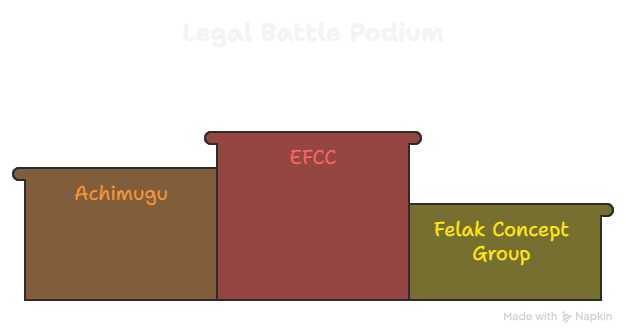
By the time the dust settled, this single controversy had spawned no fewer than four separate court cases:
- The EFCC’s criminal case against Buba and Mbagwu ($12 million money laundering charges)
- Achimugu’s fundamental rights case (FHC/CS/ABJ/626/2025) claiming harassment
- Felak Concept Group’s suit (FHC/CS/856/2025) demanding their money back
- The withdrawn case by Buba and Mbagwu seeking protection from EFCC “coercion”
Four cases, multiple billions, and everyone claiming to be the victim.
The Bail Drama
When Justice Emeka Nwite finally granted bail to Buba and Mbagwu in June 2025, the terms were eye-watering: ₦100 million each, with sureties owning landed properties in Abuja. The message was clear—this wasn’t some minor banking irregularity. This was serious business.
But here’s what makes it fascinating: the prosecution argued that the defendants’ initial bail application was “incompetent” because they had applied “from the comfort of their homes or offices when no action has been taken against them.”
Translation: You can’t ask for bail until we’ve actually arrested you. A peculiar interpretation of justice that would make Kafka proud.
The Bigger Picture
Strip away the legal jargon and WhatsApp screenshots, and you’re left with fundamental questions about Nigeria’s banking system:
Is this persecution or legitimate prosecution?
The answer depends on whom you ask. To the EFCC, this is a straightforward case of money laundering—bank executives facilitating cash transactions that should have gone through proper channels.
The numbers are staggering: $12 million in alleged violations, ₦11 billion in disputed funds, and a web of transactions that seemingly bypassed standard banking protocols.
But to SunTrust’s defenders, this looks like regulatory overreach. A bank executive asked for proper legal documentation before moving billions and got arrested for her troubles. When compliance officers start getting detained for demanding court orders, what message does that send to the banking sector?
The Human Cost
Lost in all the billions and legal maneuvering is a simple human story: Halima Buba, a 20-year banking veteran, found herself remanded in correctional facility pending bail conditions. Her crime? Possibly being too cautious about moving other people’s money without proper authorization.
The irony is thick enough to cut with a knife. In a country where banking compliance is already a nightmare of contradictory regulations and shifting political winds, the EFCC’s message seems to be: comply too much, and you’ll get in trouble. Comply too little, and you’ll get in trouble.
What exactly is the right amount of compliance?
What Happens Next
As this story unfolds in courtrooms across Abuja, the stakes extend far beyond SunTrust’s boardroom. Nigeria’s banking sector is watching closely, wondering if their own compliance procedures will suddenly become criminal offenses.
The July 17-18 trial continuation promises more revelations. Will more WhatsApp messages surface? Will other Bureau De Change operators emerge from the shadows with tales of billion-naira phone calls? Will Achimugu’s oil bloc ambitions prove legitimate or suspicious? Keep up at The Zenith Magazine, and on Linkedin.
More importantly: will Nigerian banks start demanding court orders for every EFCC request, or will they simply cave to avoid the Buba treatment? Very painful.
The Uncomfortable Truth
Perhaps the most uncomfortable aspect of this entire saga is how routine it all seems. Billion-naira transactions coordinated through WhatsApp. Cash swaps worth millions handled like corner-shop exchanges. Banking executives detained for asking for paperwork.
In Nigeria’s financial system, the extraordinary has become ordinary. The question isn’t whether this particular case represents justice or persecution—it’s whether our banking sector can survive the uncertainty of never knowing which compliance decision will land you in court.
As one banking executive told us privately: “Today it’s SunTrust. Tomorrow it could be any of us.”
The ₦11 billion question remains: In a system where asking for legal documentation can get you detained, what’s the real cost of doing business in Nigeria?
Only time—and the courts—will tell.
This story will continue to develop as the trial progresses. The implications extend far beyond one bank, one executive, and one disputed pile of money. They reach into the very foundation of how Nigeria’s financial system operates—and whether it can survive the contradictions built into its own compliance requirements.