
























A day isn’t just 24 hours—it’s whatever the cosmos decides to throw at you. And frankly, some planets make Earth look like it’s running on easy mode. So, how long is a day on each planet in our solar system?
Time is the one thing we can’t buy more of, yet we rarely stop to think about how arbitrary our 24-hour day really is.
While we’re here complaining about not having enough hours in the day, there are worlds where a single day stretches longer than an entire Earth year. Others spin so fast they make our planet look like it’s stuck in molasses.
The universe, it seems, has a twisted sense of humor when it comes to timekeeping.
Mercury: The Speed Demon That Disappoints
Mercury, the closest planet to the Sun, should be the speed king of days, right? Wrong. This is where things get deliciously complicated.
A day on Mercury lasts 176 Earth days. Yes, you read that correctly—176 days. For a planet that screams around the Sun faster than any other world in our solar system, Mercury’s day is longer than its year (88 Earth days).
It’s like watching a race car driver who’s lightning-fast on the track but takes forever to get out of the parking lot.
The reason? Mercury is tidally locked in a 3:2 resonance with the Sun. For every two orbits around the Sun, Mercury rotates exactly three times. It’s cosmic clockwork that makes Swiss timepieces look sloppy.
Venus: The Backwards Rebel
Venus takes 243 Earth days to complete one rotation. That’s longer than Mercury’s day and longer than Venus’s own year (225 Earth days). But here’s the kicker—Venus spins backwards.
While every other planet in our solar system spins counterclockwise when viewed from above, Venus decided to be different. It rotates clockwise, meaning the Sun rises in the west and sets in the east.
If you lived on Venus (and somehow survived the 900-degree surface temperature and crushing atmospheric pressure), you’d experience only 1.92 Venusian days per Venusian year.
Some scientists think Venus was smacked by a massive asteroid that literally knocked it backwards. Others suggest it’s the result of atmospheric tidal forces. Either way, Venus is the ultimate contrarian of the solar system.
Earth: The Goldilocks Standard
Our home planet takes exactly 23 hours, 56 minutes, and 4 seconds to complete one rotation—what astronomers call a sidereal day. The 24-hour day we use is actually a solar day, accounting for Earth’s orbital motion around the Sun.
Earth’s day length isn’t constant, though. It’s gradually getting longer due to tidal forces from the Moon, which is slowly stealing our rotational energy. About 1.4 billion years ago, an Earth day was only 18 hours long.
In another few billion years, Earth will be tidally locked to the Moon, and both the day and month will be about 47 current Earth days long.
We’re living in the sweet spot of cosmic timekeeping, and we don’t even realize it.
Mars: Earth’s Almost-Twin
Mars almost feels normal after the chaos of the inner planets. A Martian day—called a “sol”—lasts 24 hours and 37 minutes. That’s only 37 minutes longer than Earth’s day.
NASA’s Mars missions have to account for this slight difference. Mission controllers gradually shift their schedules to stay synchronized with their rovers and landers. It’s like permanent jet lag, but for robots millions of miles away.
Mars also has seasons like Earth, though they’re about twice as long since Mars takes nearly two Earth years to orbit the Sun. A Martian year contains 668 sols—almost exactly what you’d expect if you did the math.
Jupiter: The 10-Hour Giant
Jupiter may be the largest planet in our solar system, but it spins faster than any other. A day on Jupiter lasts just 9 hours and 55 minutes.
This rapid rotation creates Jupiter’s distinctive banded appearance. The planet’s atmosphere gets stretched into alternating bands of different colors and compositions.
Jupiter spins so fast that it’s noticeably flattened at the poles—about 7% wider at the equator than from pole to pole.
For a planet with 2.5 times the mass of all other planets combined, Jupiter’s 10-hour day is a reminder that size doesn’t always correlate with leisurely rotation. The gas giant is like a cosmic spinning top that refuses to slow down.
Saturn: The Mysterious Timer
Saturn’s day length was a puzzle that took decades to solve. Unlike terrestrial planets, gas giants don’t have solid surfaces with visible landmarks to track rotation. And Saturn’s magnetic field—usually a reliable indicator of rotation—is nearly perfectly aligned with its spin axis.
After years of study using data from the Cassini spacecraft, astronomers determined that Saturn’s day is approximately 10 hours and 33 minutes.
But here’s the weird part: different parts of Saturn seem to rotate at slightly different speeds, and the planet’s day length appears to vary by up to 8 minutes depending on when you measure it.
Saturn keeps its secrets well. Even today, there’s debate about the exact length of its day.
Uranus: The Sideways Sleeper
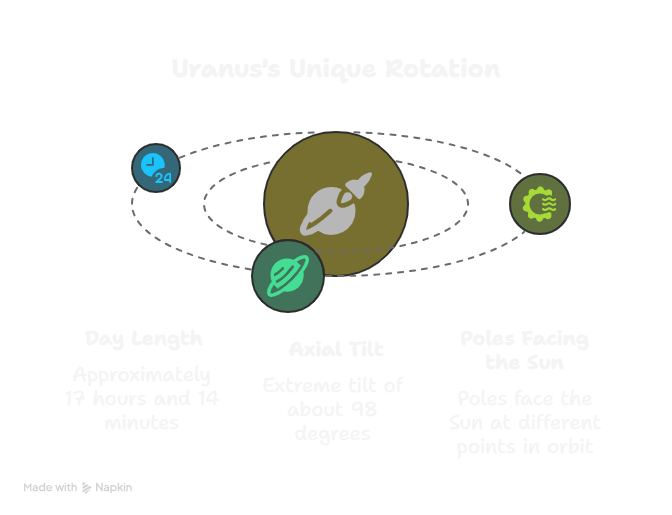
Uranus rotates on its side, with an axial tilt of 98 degrees. While most planets spin like tops, Uranus rolls along its orbital path like a ball. A day on Uranus lasts 17 hours and 14 minutes.
This sideways rotation creates the most extreme seasons in the solar system. Each pole experiences 42 years of continuous sunlight followed by 42 years of darkness. Imagine a winter that lasts longer than most human lifespans.
Scientists think Uranus was knocked sideways by a massive collision early in its formation. The planet has been rolling through space ever since, a permanent reminder of solar system violence.
Neptune: The Distant Sprinter
Neptune, the most distant planet, completes one rotation in 16 hours and 6 minutes. For a world that takes 165 Earth years to orbit the Sun, Neptune’s day is surprisingly snappy.
Neptune’s rapid rotation drives the fastest winds in the solar system—up to 1,200 mph. These supersonic winds blow in the opposite direction of the planet’s rotation, creating a meteorological mystery that scientists are still trying to solve.
The planet’s deep blue color comes from methane in its atmosphere, which absorbs red light and reflects blue. It’s beautiful, distant, and spinning faster than you’d expect from something so far from the Sun’s warming influence.
The Cosmic Perspective
These planetary day lengths reveal the chaotic, violent history of our solar system. According to NASA, Some planets were smacked backwards, others were knocked sideways, and a few managed to maintain relatively normal rotations despite billions of years of cosmic pinball.
Earth’s 24-hour day isn’t special because it’s perfect—it’s special because it’s survivable. We evolved to match our planet’s rhythm, not the other way around. On Venus, you’d experience fewer than two sunrises per year. On Jupiter, you’d see more than 2,400.
The universe doesn’t care about our human need for predictable time. It spins planets backwards, knocks them sideways, and stretches days longer than years. We’re not living in cosmic clockwork—we’re living in cosmic chaos that somehow, miraculously, created the conditions for life to emerge and thrive.
The next time you complain about there not being enough hours in the day, remember: you could be living on Venus, where a single day lasts eight Earth months. Suddenly, 24 hours doesn’t seem so bad.
After all, time is what we make of it—literally.