








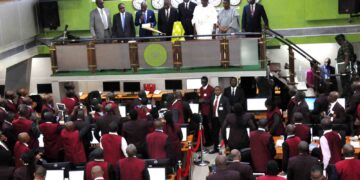

















Governor of the Central Bank of Nigeria (CBN), presided over the Monetary Policy Committee (MPC) meeting that culminated in the decision to hold the Monetary Policy Rate (MPR) at 27.50%.
This pivotal decision encapsulates the broader economic landscape of the country, characterized by a cautious approach to managing inflation without stifling the fragile recovery in non-oil GDP.
The Naira, hovering around ₦1,400/$ in the official window, and Brent crude struggling to maintain the $80/barrel threshold, underscores the delicate balance the CBN aims to strike.
Beyond the immediate implications of the MPR hold, the decision has significant regional context and ripple effects.
The stability, or stagnation depending on perspective, induced by the CBN’s pause forces regional trade partners like Ghana and South Africa to recalibrate their own monetary stances to avoid capital flight from the West African sub-region.
This phenomenon is a testament to Nigeria’s influence on the regional economy, highlighting the interconnectedness of monetary policies across borders.
As the largest economy in Africa, Nigeria’s economic decisions have far-reaching consequences, affecting not just its domestic market but also the economic strategies of its neighbors.
The human and business impact of the CBN’s decision is multifaceted. The banking sector faces immediate pressure from the liquidity squeeze implied by the MPR hold, with Tier-1 banks likely to consolidate market share due to their robust digital infrastructure.
Conversely, Tier-2 and Tier-3 lenders may see profit margins compress as lending rates remain high for SMEs.
The manufacturing sector, already grappling with the cost of borrowing persisting above 30%, is likely to stall capital expenditure for heavy industry, further exacerbating the challenges faced by import-dependent businesses dealing with FX volatility.
Despite these challenges, the CBN’s recent settlement of legacy forex backlogs offers a degree of relief for raw material procurement, a crucial step for sectors like agriculture, which, though theoretically insulated by local production, faces logistical bottlenecks that monetary policy alone cannot fix.
As Nigeria navigates this complex economic landscape, the resilience of its economy is being benchmarked not by explosive growth, but by structural endurance.
The fact that the Naira has not suffered a catastrophic depreciation following the MPC’s decision, despite high inflation, demonstrates a pivot toward market fundamentals over reactive measures.
This stability, while painful for the average consumer, serves as a standard for macroeconomic management, indicating that Nigerian institutions are prioritizing long-term currency stability over short-term liquidity injections.
Looking ahead to the next five years, as the global economy continues to evolve and regional trade dynamics shift, Nigeria’s ability to maintain this delicate balance will be crucial.
By 2028, we can expect to see a more diversified economy, with non-oil sectors contributing significantly to GDP, and a financial system that has adapted to the challenges of the past, pushing the country toward a path of sustainable recovery and growth.
The CBN’s cautious approach today may lay the groundwork for a tomorrow where Nigeria’s economy is not just resilient but thriving, a beacon of stability in a region fraught with economic uncertainty.