
























Look, I’ll be completely honest with you – writing about what’s happening in Nigeria right now breaks my heart.
We’re not just talking about statistics here; we’re talking about real families, real children, real communities being torn apart by senseless violence. And frankly, it’s gotten so much worse than most people realize.
Just this past week, at least 100 people were killed in a single overnight attack in Benue state, and that’s on top of the staggering reality that over 1,000 people have died in this region in just the past two years.
Think about that for a moment – that’s more than one person dying every single day from this conflict. It’s absolutely devastating.
Why This Crisis Hits Different
Here’s what makes this situation so particularly heartbreaking: this isn’t some distant conflict that doesn’t affect real people. One survivor, a 37-year-old man who lost his wife and child in a recent attack, told Reuters “My body is weak and my heart keeps racing” as he stood outside a hospital room.
Can you imagine? That could be any of us – a regular person just trying to live their life, and suddenly everything is gone.
The violence is primarily centered around a conflict that, on the surface, seems almost mundane: disputes between cattle herders and farmers. But don’t let that fool you – this has evolved into something much more complex and deadly.
The herders, mostly from the Fulani ethnic group, need grazing land for their cattle. The farmers need their crops to survive. When cattle trample crops and contaminate water sources, tensions explode.
But here’s where it gets really complicated – and frankly, where the government has failed these communities spectacularly.
The Perfect Storm of Problems
Climate change is making everything worse. I know, I know – climate change feels abstract when we’re talking about immediate violence, but stick with me here.
Environmental degradation and desertification in northern Nigeria are forcing herders to move south into areas like Benue state, where resources are already stretched thin. It’s like a pressure cooker that just keeps building steam.
Then you add rapid population growth, competition for limited land and water, and – let’s be real about this – religious tensions (many herders are Muslim while farming communities are predominantly Christian), and you’ve got a recipe for disaster.
James Ayatse, a traditional chief, didn’t mince words when he spoke to President Tinubu recently: this isn’t just random violence. He called it “a calculated, well-planned, full-scale genocidal invasion and land-grabbing campaign that has lasted for decades.”
Those are strong words, but when you’re watching your community get systematically destroyed, strong words might be the only thing left.
The Government’s Inadequate Response
President Bola Tinubu visited Benue state recently and announced the formation of a peace committee. That sounds nice, right? Except – and this is where I get frustrated with political responses to humanitarian crises – he’s directing security agencies to “hunt down” perpetrators, which is reactive, not proactive.
The government has tried various approaches over the years. They launched a federal joint task force in 2018, then another one called the Forest Guards just last month.
But here’s the thing that really gets me: despite 42 people being killed in May alone and 56 during the Easter period in April, “there is little evidence of meaningful efforts toward justice,” according to Human Rights Watch.
Both the state and national governments have tried various policies over the years but none have proved successful yet.
Mr Adamu says a federal joint task force was launched in 2018 and then another one last month, the Forest Guards.
“This national system aims to recruit armed operatives to secure forest reserves from terrorists and criminals.”
Public affairs analyst Sam Philip, who lives in Makurdi, says the conflict has not been getting the attention it deserves for years, with the government focusing on other security crises like the Boko Haram insurgency in the north-east, the demand for secession in parts of the south-east and a wave of kidnapping for ransom in the north-west.
“I feel this issue has been ignored for long in terms of real attention from the government and that is why things continue to escalate,” he noted.
How can it be resolved?
Mr Adamu says any solution needs to have both security and economic elements.
The government needs to “deploy more tactical and intelligence-based special forces to Benue State, ensuring their presence is sustained and adaptable to shifting threats”, he says.
There also needs to be more grazing land for the herders so they don’t come into conflict with farmers.
“The aim should be to ensure it is equitable and provides viable, sustainable alternatives for pastoralists,” Mr Adamu said.
Former President Muhammadu Buhari did come up with such a plan, however this was rejected by states in the south, who saw it as a way of giving the Fulanis a share of their land.
NO fewer than 59 people were killed in four separate attacks in Borno, Kano, Kebbi and Plateau states on Friday and Saturday.
While 30 people were killed in Kebbi State, 12 persons, who were identified as wedding guests were murdered in Plateau State.
In Borno State, 12 persons died in a suicide bombing carried out in a fish market by a woman, while in Kano State, a military mortar bomb went off along the Eastern Bypass in Kano, the State capital, on Saturday, killing five persons in the process.
12 die in Borno suicide bombing
Local sources in Konduga LGA of Borno State told one of our correspondents on Saturday that the suicide bomber was burnt beyond recognition.
BBC also gathered that those who were injured in the incident were rushed to a nearby hospital.
“It is a busy joint where people come together, buy food and eat. There were passersby and others.
“Everything was going normal until a loud sound was heard. It was a devastating moment. Many people died,” another local source in Borno confirmed
It was learnt that the victims were laid to rest on Saturday in line with Islamic rites at the Konduga cemetery.
BBC also gathered that separate burial arrangements were done for the victims.
The Borno State Police Command confirmed the suicide incident in a statement issued by the Police Public Relations Officer, Nahum Daso, on Saturday.
According to the statement, the explosion occurred around 9.30 pm on Friday when the suicide bomber, who had an IED strapped to her body, infiltrated a crowded section of the market and detonated the device, killing 12 people.
Police probe Kano blast
In Kano State, the blast on Saturday was reportedly from a military mortar bomb suspected to be in a truck transporting carbine.
Confirming the incident, the Kano State Commissioner of Police, Ibrahim Bakori, said investigations had commenced on the matter, just as he confirmed that the vehicle involved in the incident came from Yobe State.
“Five people have been confirmed dead, while 10 others are currently receiving treatment in hospital,” the commissioner said.
He added that it was too early to say whether any security personnel were among the victims.
Bakori assured the public that the police would carry out a comprehensive investigation on the matter, even as he called for calm and cooperation.
“We are working diligently to uncover the cause of the explosion and assess the full extent of the damage. More details will be made available as the investigation progresses,” Bakori stated.
Bandits kill 30 in Kebbi
Meanwhile, the Kebbi State Government has confirmed that 30 people lost their lives in the recent wave of banditry attacks in parts of the Zuru Emirate, describing the development as deeply tragic and unacceptable.
The confirmation came during a condolence visit led by the State Deputy Governor, Senator Umar Abubakar Tafida, to the affected communities of Tadurga in Zuru Local Government Area and Kyebu in Danko Wasagu Local Government Area.
The deputy governor, who represented Governor Nasir Idris, sympathized with families of the deceased and assured residents that government will intensify efforts to strengthen security across the state
Senator Tafida said the state government will take decisive steps to secure all vulnerable areas, including blocking all illegal entry points into Tadurga and Kyebu, which have become targets of deadly attacks.
He offered prayers for the repose of the victims and asked Almighty Allah to grant their families the fortitude to bear the loss.
In a compassionate gesture, the Deputy Governor announced a relief donation of N50 million to the affected communities—N25 million each to Tadurga and Kyebu—to support victims’ families and rebuild the devastated communities.
Mob kills 12 Plateau wedding guests
The Plateau State Police Command has arrested 22 suspects in connection with the killing of 12 travellers by irate youths in Mangun village, Mangu Local Government Area of the state, on Friday night
Police Public Relations Officer of the command, Alfred Alabo, confirmed this in a statement on Saturday.
The Speaker of the House of Representatives, Tajudeen Abbas, urged security agencies to bring the perpetrators to justice.
We gathered that the victims were passengers of an 18-seater bus belonging to Ahmadu Bello University Zaria, Kaduna State.
It was learnt that the travellers, including children, were reportedly attacked in an ambush while travelling from Zaria Local Government Area of Kaduna State to attend a wedding ceremony in Qua’an Pan LGA of Plateau State.
According to eyewitnesses, the attack occurs around 8 pm when the travellers took a wrong turn and stopped to ask for directions.
“Instead of helping the confused travellers, the assailants, driven by deadly assumptions, descended on the bus, viciously attacking the occupants, killing 12, injuring 12 others, and setting the vehicle ablaze.
“Several others sustained injuries and were rushed to hospitals in Mangu for medical attention,” an eyewitness said.
It’s like putting a band-aid on a severed artery. The problem requires fundamental solutions, not just more security forces.
What Actually Needs to Happen
Security analyst Kabir Adamu gets it right when he says any real solution needs both security and economic elements. You can’t just send more soldiers and expect the underlying problems to disappear. These communities need:
Immediate Security: Yes, deploy more tactical forces, but make sure they’re intelligence-based and adaptable. Random military presence doesn’t solve targeted attacks.
Long-term Economic Solutions: This is the big one. The government needs to create viable grazing areas for herders so they don’t have to conflict with farmers. Former President Muhammadu Buhari actually tried this, but southern states rejected it because they saw it as giving away their land to outsiders.
Climate Adaptation: We need serious investment in helping both communities adapt to changing environmental conditions. Drought-resistant crops, better water management, alternative livelihoods – the works.
The Human Cost We Can’t Ignore
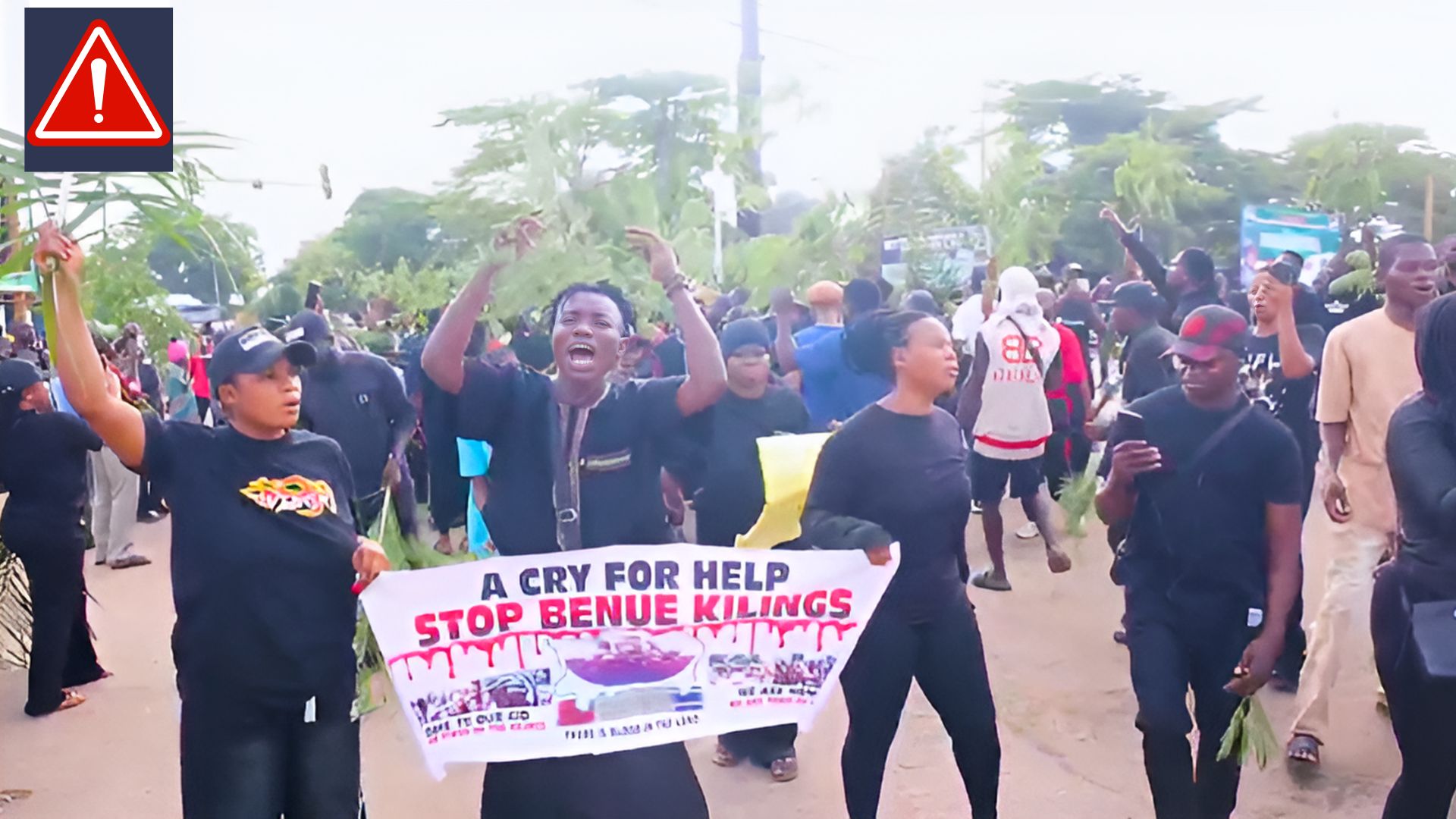
Protesters in Makurdi, Benue’s capital, are literally begging: “Listen to us, we are tired, please stop Benue killings!” Can you imagine having to protest just to ask for your basic right to live safely?
And it’s not just Benue. The violence is spreading. Just recently, 59 people were killed across four different states in separate attacks – suicide bombings, military accidents, banditry, mob violence. It’s like Nigeria is experiencing multiple security crises simultaneously.
Why This Matters Beyond Nigeria
Look, I know it’s easy to think “that’s happening over there, not my problem.” But displacement from violence like this creates refugee crises, economic instability spreads across borders, and frankly, when we ignore humanitarian disasters, they tend to get worse, not better.
The international community has largely been focused on other crises – and I get it, there are a lot of terrible things happening in the world right now. But over 1,000 people dying in two years in a single state should be getting more attention than it is.
What Gives Me Hope
Despite everything, there are community leaders on both sides trying to find peaceful solutions. Fulani leader Baba Othman Ngelzarma told the BBC that his community isn’t behind the killings and that they’ve “never allowed any of our people to attack or kill others.”
That kind of leadership takes courage when tensions are high.
There are also analysts like Kabir Adamu who are providing concrete, actionable solutions instead of just political rhetoric. When experts focus on both immediate security needs and long-term economic development, that’s when real change becomes possible.
The Bottom Line
This crisis in Nigeria isn’t just about herders versus farmers. It’s about what happens when governments fail to address underlying economic and environmental problems before they explode into violence. It’s about communities that deserve better than being caught in cycles of attack and revenge.
Most importantly, it’s about real people – parents, children, farmers, herders – who just want to live their lives in peace. Until we start treating this as the humanitarian emergency it is, rather than just another political problem to manage, those charred bodies and shattered lives will keep piling up.
And honestly? That’s not acceptable. Not in 2025, not anywhere, not anymore.